China's ETF boom and the rise of long-term capital
Exchange-traded funds have grown into a primary vehicle for long-term capital flowing into China's A-share market, a shift that changes how that capital behaves compared with the trading-driven flows that have historically dominated mainland equity turnover.
From niche product to mainstream vehicle
ETFs listed on the Shanghai and Shenzhen exchanges started as a relatively narrow product category tracking broad indices like the CSI 300, but the product range has since expanded into sector, thematic, and increasingly specialised strategies. Growth in assets under management has been driven less by retail trading interest and more by institutional and long-horizon allocators, including insurance funds and pension-related vehicles, using ETFs as an efficient way to gain diversified equity exposure without picking individual names.
Why ETF flows behave differently
Passive, index-tracking vehicles channel flows in a more rules-based, steady pattern than the sentiment-driven trading that has periodically characterised mainland retail activity. A market with a larger ETF base tends to see somewhat more orderly price discovery during stress periods, since a portion of trading volume is mechanically tied to index rebalancing and creation-redemption activity rather than discretionary positioning. Volatility remains, though its texture changes, and regulators have at points actively encouraged ETF growth partly for this stabilising characteristic.
The composition shift
Broad-index products still anchor total ETF assets, but the share held in sector and thematic ETFs, tracking areas like technology, new energy, and specific industrial policy priorities, has grown as both product issuers and allocators have looked for more targeted exposure. This composition shift is itself a signal of where institutional conviction is concentrating within the broader equity market, since launching and scaling a thematic ETF requires sustained underlying demand to be commercially viable for the issuing fund house.
Reading the AUM trajectory
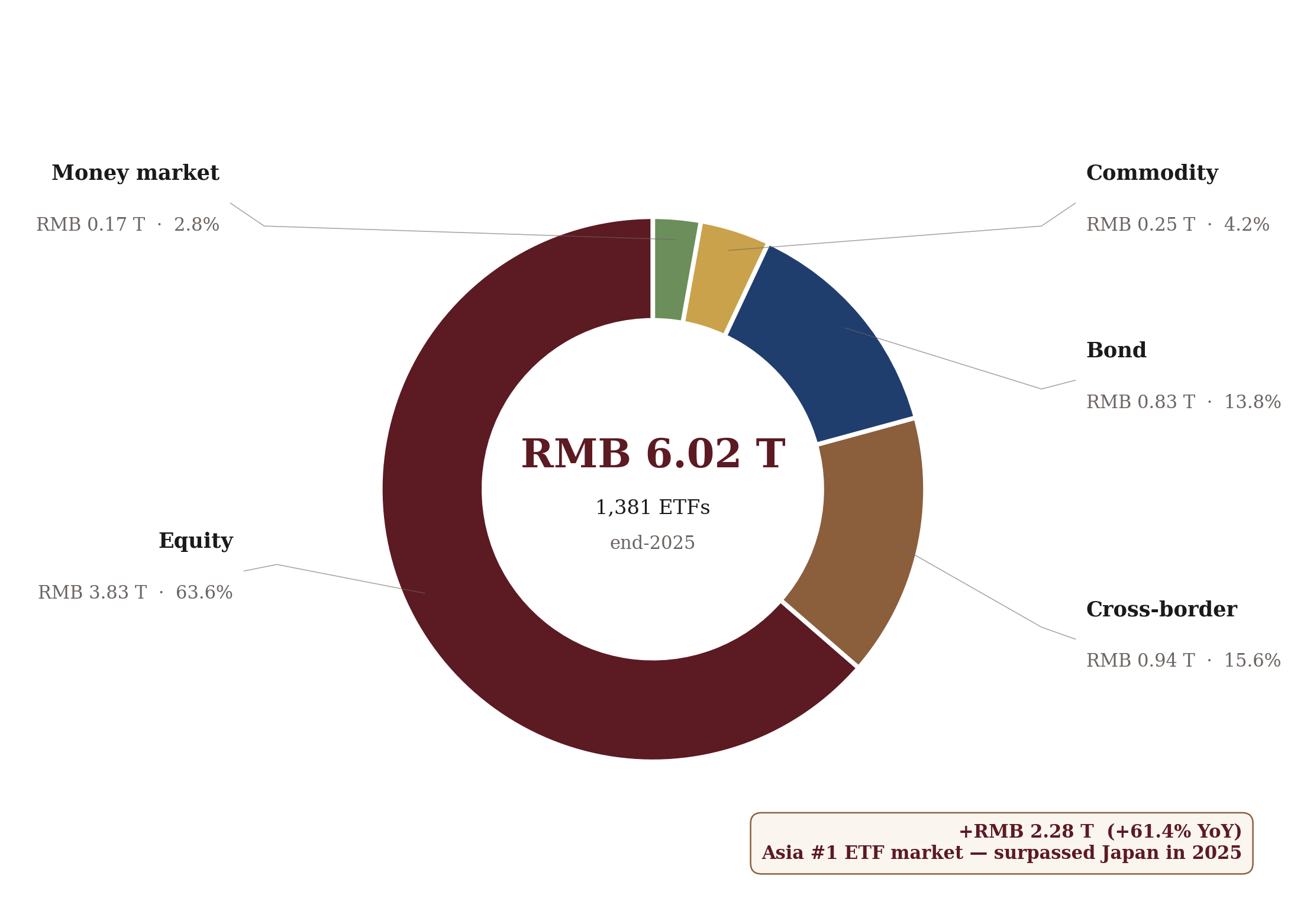
The chart below shows the ETF AUM build over time alongside the 2025 composition by category. The trajectory matters more than any single year's level: a steepening AUM curve alongside a broadening composition mix suggests the long-term capital base supporting Chinese equities is both growing and diversifying, a structural development distinct from any single quarter's market performance.