Why the Fed says it cannot move the price of eggs
On June 17, at his first news conference as chair of the Federal Reserve, Kevin Warsh was asked about the cost of groceries. His answer drew a line between two things a central bank treats very differently: the general level of prices, which it works on over time, and the price of any one item, which it does not set.
Warsh took the oath as the 17th chair of the Federal Reserve on May 22, and the June 16 to 17 meeting was the first he presided over. The Committee held its target range for the federal funds rate at 3.50 to 3.75 percent. At the news conference that followed, he framed what the Fed can reach and what it cannot. Putting it in terms of a grocery run, he said the Fed "cannot have a very significant effect on particular prices, the price of oil in the markets today, or even the price of a dozen eggs" (June 17 FOMC press conference, transcript).
The price level and the price of one thing
Monetary policy operates on aggregate demand. By setting the policy rate, a central bank leans on how much spending and credit run through the wider economy, and through that on the general price level, the average across the basket of goods and services households buy. That average is what an inflation target refers to.
The price of one good sits in its own market. Eggs moved with avian influenza and the size of the laying flock; oil moves with production decisions and with conflict. A central bank can shape the trend of the overall price level across a span of quarters and years. It does not reach into the market for a carton of eggs. The distinction is what lets a policymaker accept responsibility for the average while declining it for the item.
The separation matters for how a target is read. When a relative price jumps, eggs after a cull, gasoline after a supply shock, it can lift the headline figure for a time without changing the trend the policy rate is set against. A central bank that owned the whole basket would be judged on the laying flock. One that owns the average asks to be judged on the path of that average over a run of quarters.
What the June projections carry
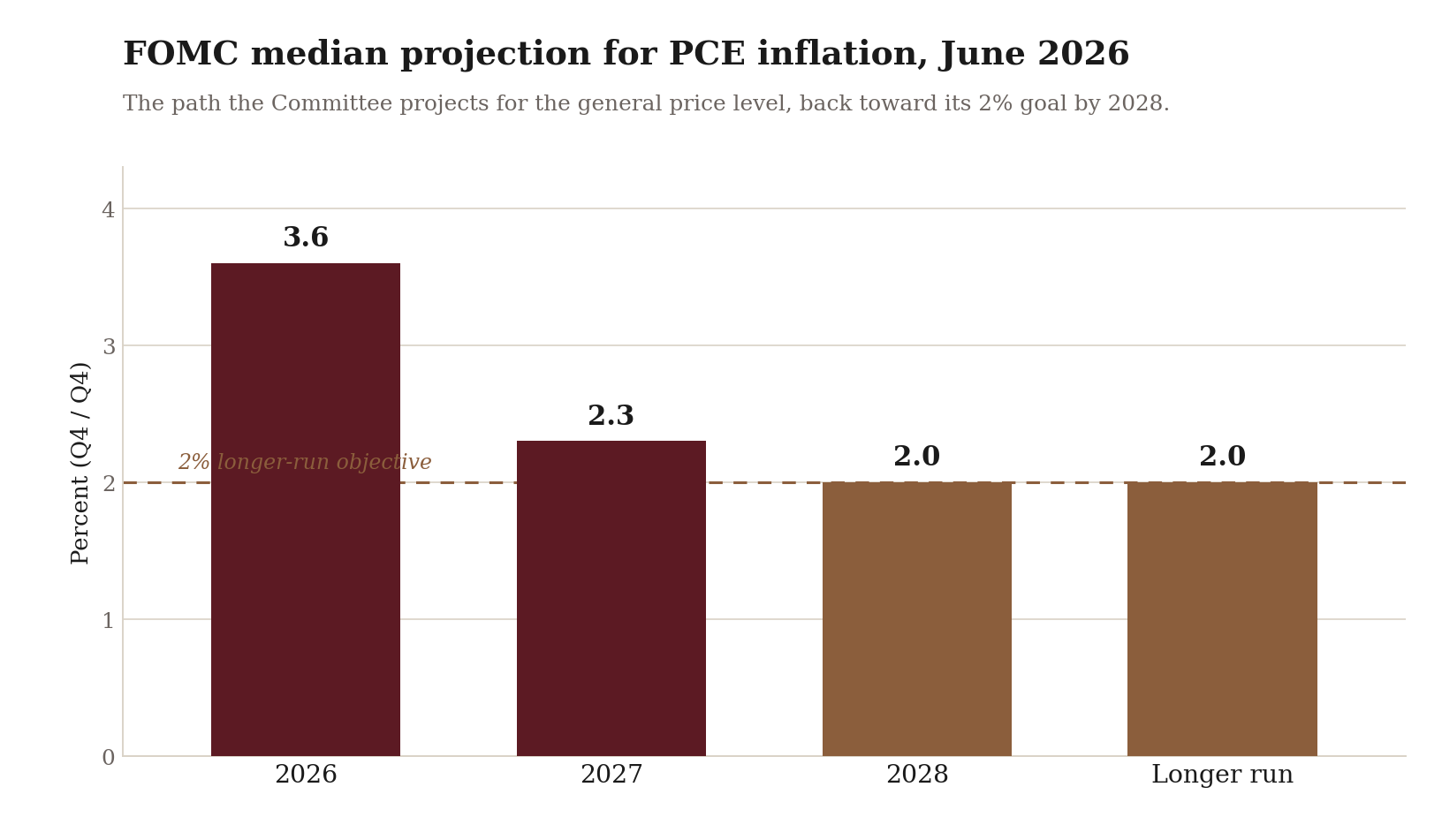
The Committee's Summary of Economic Projections, released the same afternoon, shows where participants expect that overall measure to sit. The median projection for PCE inflation is 3.6 percent for 2026, easing to 2.3 percent in 2027 and 2.0 percent in 2028, in line with the 2 percent longer-run figure. In March the median for 2026 had been 2.7 percent, so the near-term path moved higher. Core PCE inflation, which strips out food and energy, carries a median of 3.3 percent for 2026. The median for the unemployment rate sits at 4.3 percent. The median projected path for the federal funds rate is 3.8 percent at the end of 2026, above the range the Committee held in June.
Read as a set, the projections describe a Committee steering the aggregate back toward target over years, while holding the rate steady in the present.
A frame that fits the communication push
The grocery framing also sits with the way Warsh has said he wants the Fed to speak. In his first meeting he set out a review of how the Committee communicates, including task forces to examine its practices. Drawing a clean boundary around what the tool does, the price level rather than any one price, is the kind of line that survives repetition in public. It tells a household what to expect from the central bank, and what to expect from the egg market instead.
The cross-market read
For desks in Asia, the read runs through the rate path more than the grocery aisle. A chair who disclaims influence over any one price, while committing the Committee to the 2 percent average, is pointing attention at the aggregate and at the policy rate that steers it. With the year-end median above target and the projected path holding rates higher into 2026, the case for an early cut carries less weight in the price.
Dollar funding costs, the level of US yields, and the local-currency curves that price against them take their cue from that path. The egg line, read closely, marks the boundary of the tool, and points to where the Fed has placed its weight.