China's futures and derivatives market: the six exchanges and 2025 scale
China's listed derivatives trade across six exchanges, each carrying a defined product remit rather than competing head to head on the same contracts, an organisational choice that shapes how volume and access are distributed across the market.
Six venues, defined remits
Commodity futures trade mainly on the Shanghai Futures Exchange, the Dalian Commodity Exchange, and the Zhengzhou Commodity Exchange, each specialising in different underlying commodity groups, from metals and energy to agricultural products. Financial futures, including index and treasury bond futures, trade on the China Financial Futures Exchange. The Shanghai International Energy Exchange handles crude oil and other internationally referenced energy contracts, and the Guangzhou Futures Exchange, the newest of the six, has focused on contracts tied to green and new-economy commodities since its 2021 launch. The Securities Association of China and the CSRC oversee the regulatory framework across all six.
Why the remit-based structure matters
Splitting product types across dedicated exchanges, rather than running them on a single combined venue, concentrates liquidity and expertise around specific contract families and gives the regulator a cleaner line of sight into risk by product category. It also means market participants need relationships across multiple exchanges depending on their hedging needs, a structural feature that differs from markets like the CME Group in the United States, which consolidates a broader range of products under one corporate umbrella.
Widening foreign access
Qualified foreign institutional investors have gained gradually widening access to specific commodity and financial futures contracts over the past several years, a deliberate, contract-by-contract opening rather than a blanket one. Crude oil futures on the Shanghai International Energy Exchange were among the earlier products opened to direct foreign participation, reflecting the strategic interest in establishing an Asian price benchmark for oil alongside the existing benchmarks set in London and New York.
Reading the 2025 composition
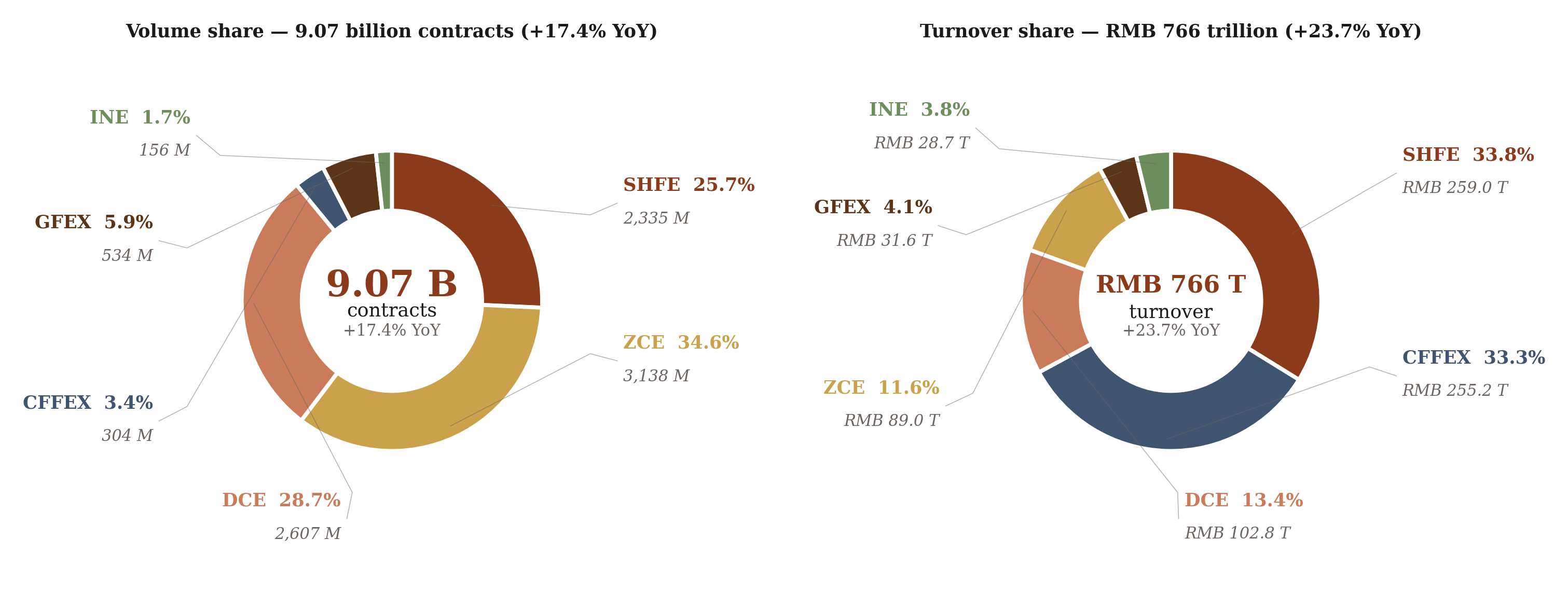
The chart below breaks down 2025 trading volume and turnover by exchange. The composition shows where market activity actually concentrates, which tends to track underlying economic exposure: commodity futures volume moves with manufacturing and construction demand, financial futures volume moves with equity and bond market volatility. A shift in the relative weight between commodity and financial futures over time is itself a signal worth tracking, since it reflects where market participants are currently looking to hedge.